
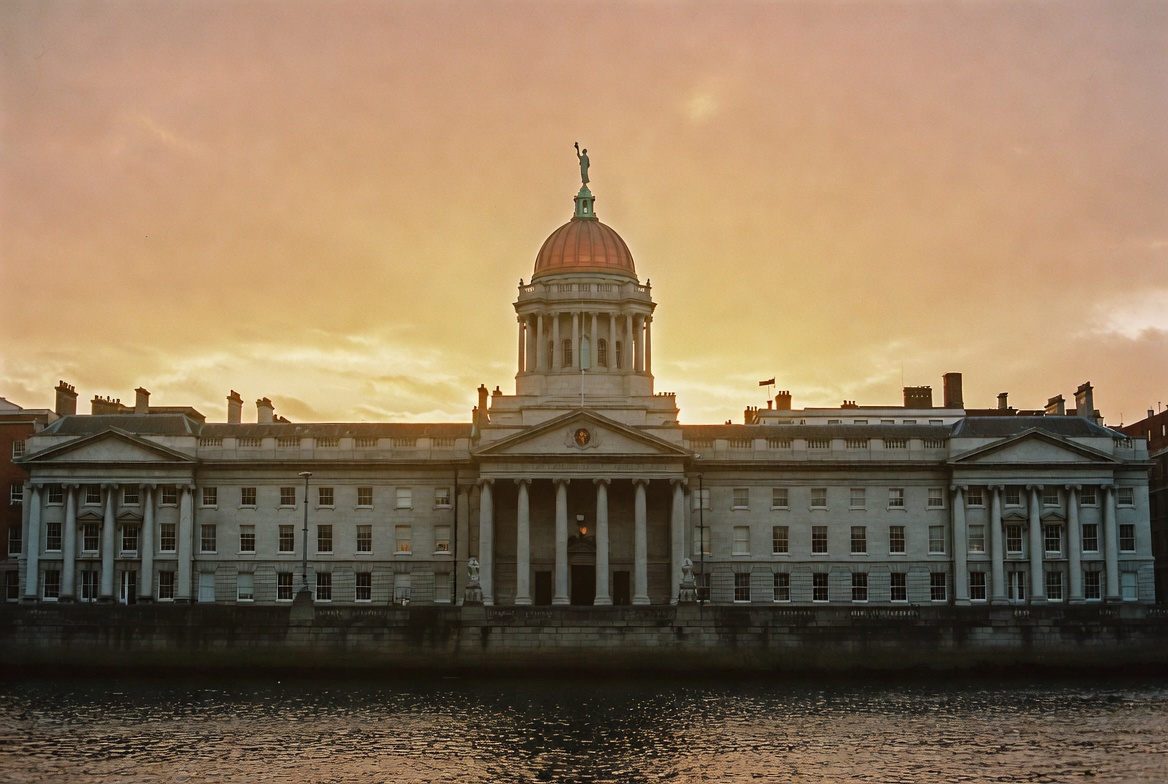
The Custom House is the most accomplished neoclassical building in Ireland and arguably in these islands. Set on the north bank of the Liffey, fronted by an arcade and crowned by a copper-clad dome bearing a statue of Commerce, it was the largest civic project of late-Georgian Dublin and remains the visual climax of the river's eastern reach.
Gandon's Commission
James Gandon, an English architect of partial Huguenot descent, was invited to Dublin in 1781 by John Beresford, the all-powerful Commissioner of Revenue. The decision to move the customs house downriver from its old site at Essex Bridge was bitterly opposed: rioters tried to demolish the foundations, and Gandon is said to have carried a sword to inspections. Construction took ten years and cost over £200,000 — the most expensive single building project in eighteenth-century Ireland.
The Sculpture
The keystones of the arcade — fourteen heads representing the rivers of Ireland and the Atlantic — were carved by Edward Smyth and are amongst the finest sculpture of their period anywhere. The four pavilions support figures of Industry, Plenty, Mercury and Neptune; the great dome (added against Gandon's intentions) is surmounted by a 16-foot copper figure of Commerce.
"The most magnificent and best executed structure perhaps in Europe."— Sir John Carr, on visiting Dublin in 1805
The Burning of 1921
On 25 May 1921 the IRA's Dublin Brigade, under Tom Ennis and Oscar Traynor, set fire to the Custom House in a deliberate attempt to destroy the records of British administration in Ireland. The records of the Local Government Board, the Inland Revenue, and the Stamp Office were almost completely lost. Five Volunteers were killed, eighty captured. The blaze burned for five days; the building's interior, dome and copper roof were entirely destroyed. The IRA had achieved one of its most spectacular operations and dealt a heavy administrative blow to British rule, but at a cost the Dublin Brigade could not easily absorb.
Reconstruction
Reconstruction began under the Free State in 1926 and continued — in successive phases — until the early 1990s. The exterior was returned to Gandon's design but the interior, gutted by fire, was rebuilt in modern materials. The dome, now of Portland stone rather than copper, no longer has the colour Gandon intended; the statue of Commerce above it, however, is the original, lowered by hand and saved before the fire reached it.
What You'll See on the Tour
- The river façade, the arcade, and Smyth's keystones of the rivers
- The four pavilions and the dome
- The Custom House Visitor Centre and the 1921 burning exhibition
- The memorial to the Custom House Burning Volunteers
Visiting Notes
The Custom House continues to function as a government building (the Department of Housing). The Visitor Centre on the riverside is fully accessible. Our walking tours include the exterior in full and the Visitor Centre on request.