Trinity College was founded by royal charter of Elizabeth I in 1592, as "the mother of a university" intended — in the queen's hopeful phrase — to civilise Ireland. Four hundred and thirty years later it is still a working university, still arranged around the same cobbled squares, and still in possession of the most famous illuminated manuscript in the Western tradition.
Foundation and Plantation
Built on the suppressed Augustinian Priory of All Hallows, just outside the medieval city walls, Trinity was an instrument of the Tudor reconquest of Ireland. Its first provost was Adam Loftus, Archbishop of Dublin; its first students were sons of the New English administration. For its first two centuries, Catholics and Dissenters were excluded from full participation, and the College was firmly the institution of the Protestant Ascendancy.
The Long Room
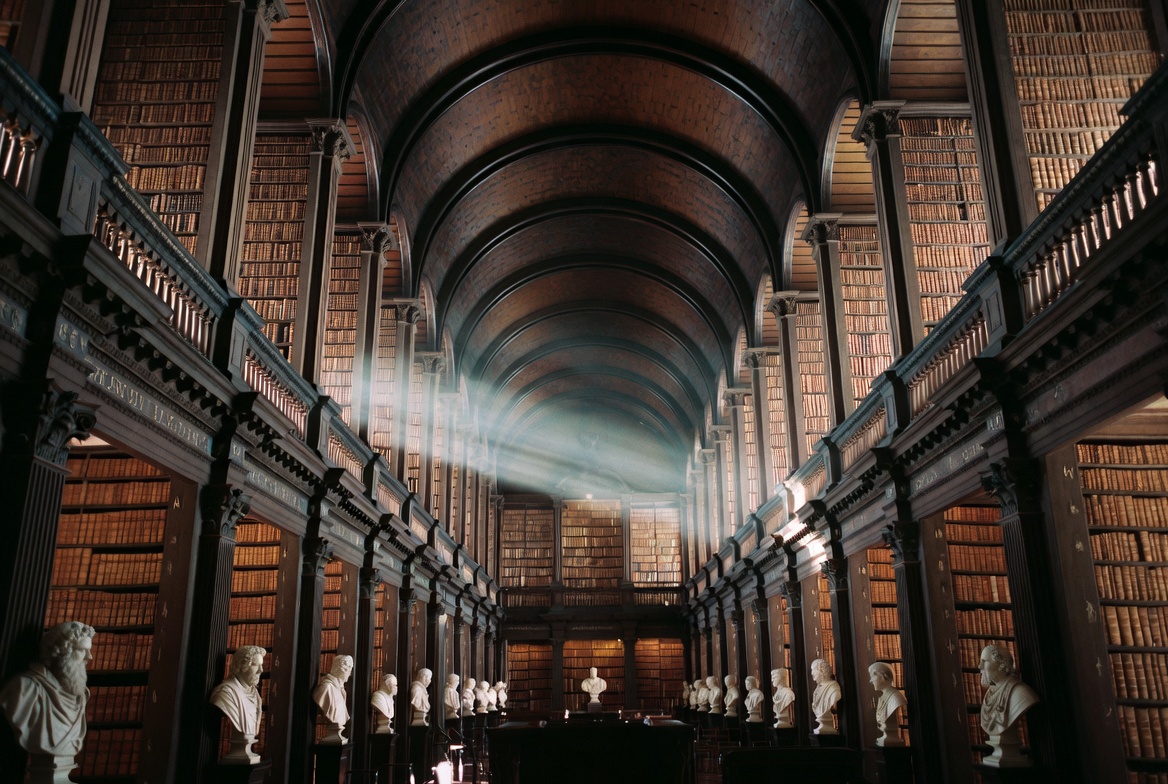
The Library's Long Room, completed in 1732 and re-roofed with its present barrel vault in 1860, is sixty-five metres long and houses some 200,000 of the Library's oldest volumes. The carved oak shelving, the marble busts of the College's worthies, and the exceptionally rare 15th-century harp known as the Brian Boru harp combine to produce one of the great library interiors anywhere in the world.
"The most beautiful room I have ever entered, and a confounding rebuke to the modern preference for fluorescent strip-lighting."— Anthony Cronin
The Book of Kells
The Book of Kells is a Latin Gospel manuscript created by Columban monks around the year 800, possibly at the monastery on the Scottish island of Iona, possibly at Kells in County Meath, almost certainly with materials sourced from both. It contains the four Gospels of the New Testament along with a small assembly of preliminary texts, written and illuminated on calf-skin vellum. The decoration is the most elaborate surviving from the Insular tradition: every page rewards close looking, and several — the Chi-Rho page at the opening of Matthew, the symbols of the Evangelists — are masterpieces of design.
The Book has been at Trinity since 1661, deposited for safekeeping after the Cromwellian wars and never returned to Kells. It is displayed open in the Library's exhibition, with the pages turned approximately every twelve weeks.
Modern Trinity
Catholics were admitted from 1793; women from 1904; the College's bicentenary in 1992 was marked by a complete restoration of the Old Library and the development of a new Visitors' Centre. The university remains compact: under 20,000 students inside walls that still take twenty minutes to walk around.
What You'll See on the Tour
- Front Square, the Campanile, and the Provost's House
- The Old Library and the Long Room
- The Book of Kells exhibition
- The Examination Hall and the Public Theatre
- The Museum Building (Deane & Woodward, 1857) — Ruskinian Gothic at its most exuberant
Visiting Notes
The Old Library is reached by stairs; an accessible entrance is available with advance notice. The Long Room is partially closed for conservation through 2026; tours adapt to the available rooms.