
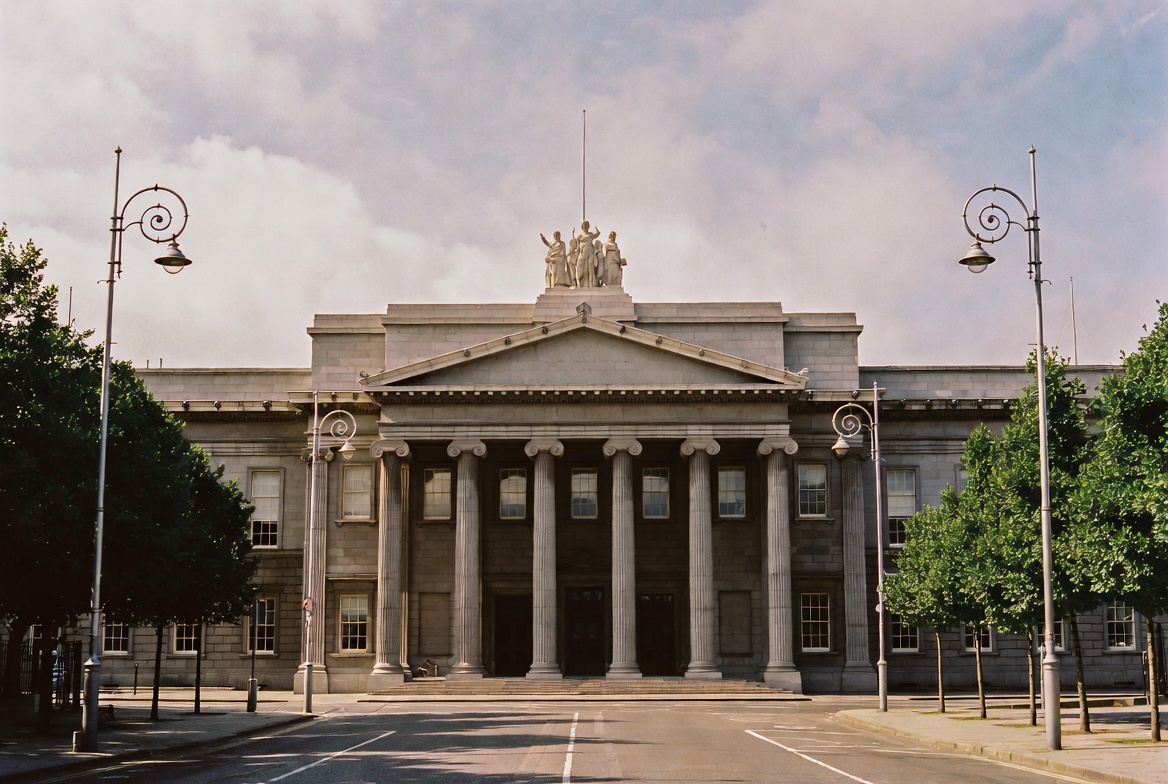
The General Post Office on O'Connell Street is one of the few buildings in modern Dublin that everyone in the city, regardless of class or background, recognises immediately. Its great Ionic portico is the de facto national monument; the bullet marks still visible on its columns are not symbolic but literal.
Francis Johnston's Building
The GPO was designed by Francis Johnston, the same architect who built the Chapel Royal at Dublin Castle and oversaw the conversion of the old Irish Houses of Parliament into the Bank of Ireland. The portico of six fluted Ionic columns supports a pediment surmounted by three statues by John Smyth: Mercury (commerce), Hibernia (Ireland) and Fidelity. The building opened in January 1818, three weeks before the foundation of the public mail service it was built to house.
Easter Week, 1916
At noon on Easter Monday, 24 April 1916, members of the Irish Volunteers and the Irish Citizen Army occupied the GPO. From the steps Patrick Pearse read aloud the Proclamation of the Irish Republic. Inside, James Connolly directed the defence; Seán Mac Diarmada and Joseph Plunkett were among the leadership; the poet Joseph Mary Plunkett, dying of tuberculosis, lay on a mattress in a back room. For six days the building was the headquarters of the rebellion. By the end of the week it had been shelled to a roofless ruin by the gunboat Helga in the Liffey and by artillery on Prince's Street.
"In the name of God and of the dead generations from which she receives her old tradition of nationhood, Ireland, through us, summons her children to her flag, and strikes for her freedom."— from the Proclamation of the Irish Republic, read at the GPO, 24 April 1916
Reconstruction and After
The GPO was rebuilt by the Free State to the original design but with a modernised interior; it reopened in 1929. In the central public office, the bronze statue of The Death of Cú Chulainn by Oliver Sheppard, installed in 1935 as a memorial to the Rising, has become inseparable from the building itself. The portico still bears the marks of the artillery and the rifles of Easter Week — preserved deliberately at the building's restoration.
What You'll See on the Tour
- The portico, statues and bullet marks
- The public office with the Cú Chulainn memorial
- The site of Pearse's reading
- The route of the 1916 garrison's evacuation through the burning streets
- The GPO Witness History exhibition (separate admission)
Visiting Notes
The GPO continues to operate as a working post office. The Witness History exhibition is reached through the eastern entrance and is fully accessible. Our tours visit the portico and public office without exhibition admission.