
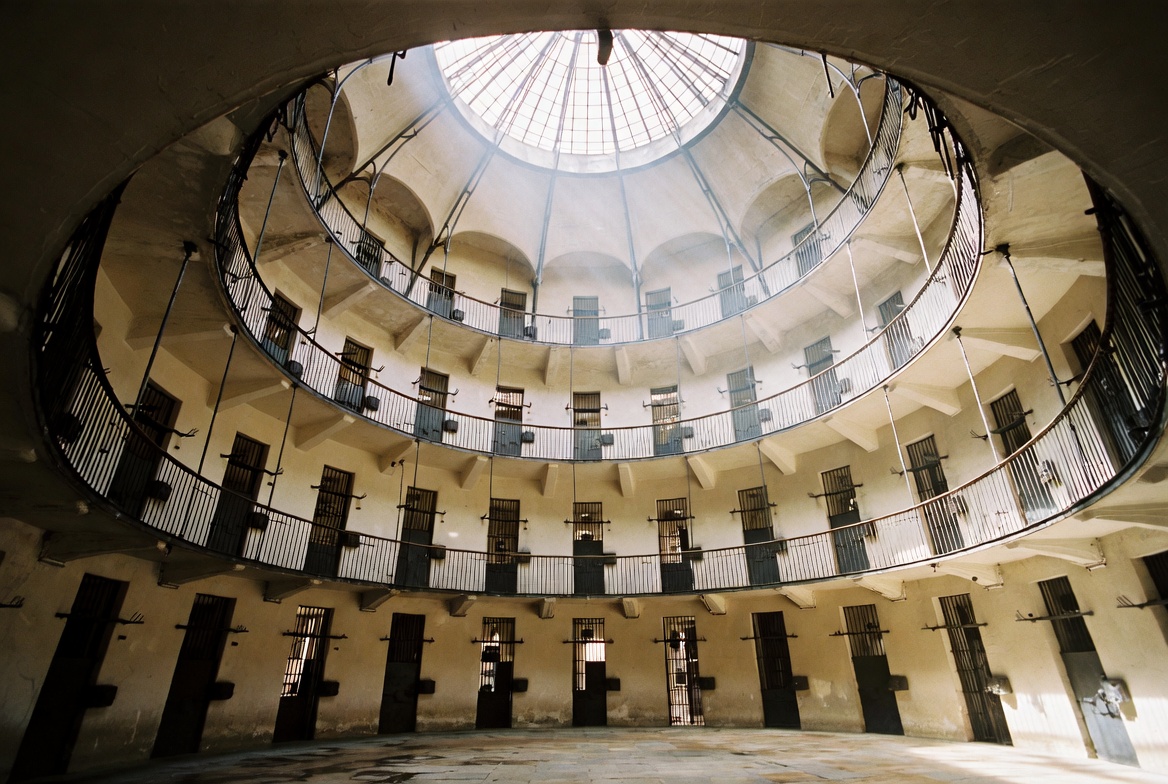
Kilmainham Gaol opened to its first prisoners in August 1796. For the next 128 years it served as both the Dublin County Gaol and, repeatedly, as the holding place of every leading generation of Irish republicans. By the time it closed in 1924, the building had become — in the phrase of the historian Pat Cooke — "a national place of memory in the form of a prison."
An Enlightenment Prison
The original 1796 building reflected the late-eighteenth-century reform ideal: separate cells for individual reflection, a chapel, an exercise yard, and a deliberate severity of architecture. The west wing, with its low arched corridors and stone-flagged floors, dates from this first phase. By the 1840s the gaol was overwhelmed by the arrests of the Famine years, and several thousand men, women and children were held in cells designed for a fraction of that number. Many were transported to Australia from these corridors.
The East Wing
The Victorian East Wing, completed in 1864, is one of the great surviving examples of the panopticon ideal: a tall, top-lit hall arranged so that a single warder at ground level can observe every cell door. It is the most photographed interior in the building and has been the setting of many films, in part because almost no other complete Victorian prison interior of comparable scale survives anywhere.
"The valley of Glenmalure is in my mind, but I am in Kilmainham."— Patrick Pearse, written from his cell, 2 May 1916
The 1916 Executions
Between 3 and 12 May 1916, fourteen leaders of the Easter Rising were court-martialled and shot in the Stonebreakers' Yard at the rear of the gaol. They included Patrick Pearse, Thomas MacDonagh, Joseph Plunkett (married hours before his execution to Grace Gifford in the prison chapel), James Connolly (carried in on a stretcher, shot tied to a chair) and the youngest signatory, Seán Mac Diarmada. The executions, more than the rebellion itself, transformed Irish public opinion and made Irish independence inevitable.
Civil War, Closure, Restoration
In the Civil War of 1922 – 23 the prison held over 4,000 anti-Treaty Republican prisoners, including Éamon de Valera. The last prisoner — Éamon de Valera again, briefly — was released in 1924 and the gaol closed. Its restoration as a museum from the 1960s was largely the work of volunteers; today it is administered by the Office of Public Works and is one of the most visited heritage sites in Ireland.
What You'll See on the Tour
- The 1796 west wing and the original cells of the United Irishmen
- The Victorian panopticon East Wing
- The Stonebreakers' Yard
- The chapel where Joseph Plunkett married Grace Gifford
- The prisoners' inscriptions throughout the wings
Visiting Notes
Kilmainham Gaol is reached by stairs throughout much of the building; an accessible route covers the East Wing and chapel. Tickets are timed and book up well in advance: we recommend booking the Irish Chronicals walk that includes timed entry at least three weeks ahead.